Game-based Assessment of Physics Competencies, Misconceptions, and Temporal Progressions
GAPCo
Games
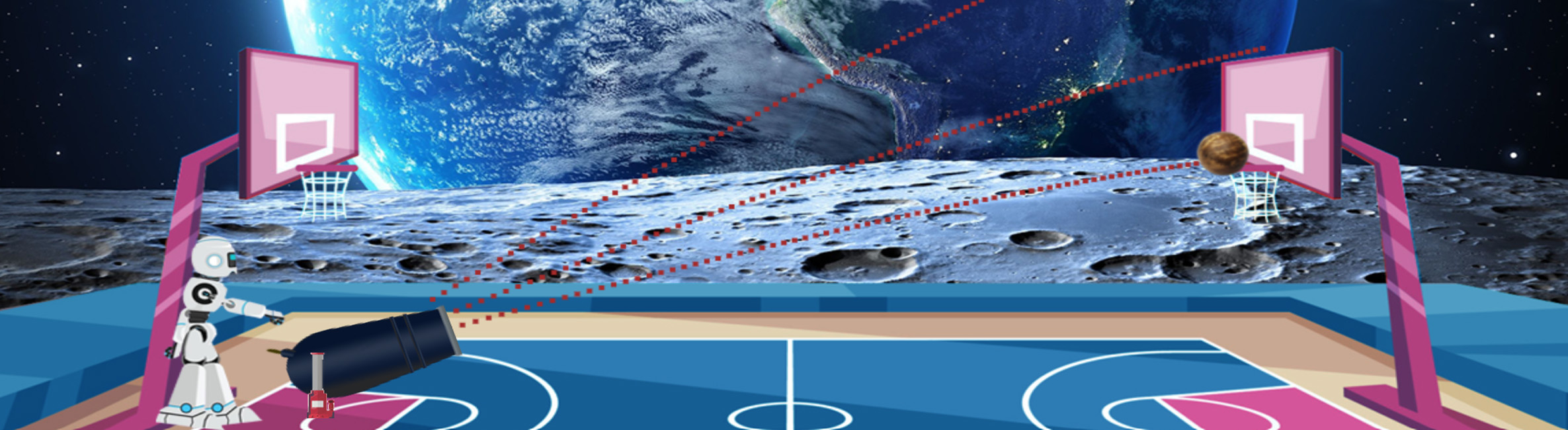
The Basketball Challenge
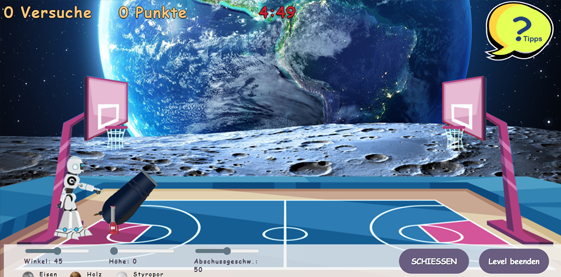
The game focuses on core physics concepts related to force and motion, particularly ballistic trajectories and the effects of gravity, friction, and air resistance. Its central goal is to help learners understand and apply these principles in an interactive simulation aim is to support learners in exploring and applying these principles within an interactive simulation environment. Players experiment with variables such as initial velocity, trajectory, throwing angle, gravity, friction, and air resistance by shooting balls made of different materials (iron, plastic, wood, and styrofoam) into a basketball hoop. They can adjust the cannon’s angle, height, and shooting power, with three attempts per ball. The different materials and environmental settings allow students to observe how physical parameters systematically influence motion behavior.
To support learning structured learning, the app uses follows an eight-level progression system that introduces introducing increasingly complex physical challenges. The structure is based on a competency model derived from international curricula, with a particular emphasis on particular reference to Switzerland’s Lehrplan 21. Early levels focus on basic ideas foundational relationships like initial velocity and throwing angle, while later levels require learners to account for require learners to integrate more advanced factors such as gravitational differences on other planets or environmental influences like wind or vacuum. Each level highlights a specific physics concept and reinforces understanding through hands-on application encourages strategic adaptation rather than trial-and-error exploration. The gradual increase in difficulty is designed to challenge learners without overwhelming them, fostering effective and lasting knowledge acquisition The gradual increase in difficulty is designed to challenge learners without overwhelming them and to scaffold conceptual development. At the same time, the progression allows the examination of how early skill acquisition relates to later performance in more complex transfer tasks.
Teachers may conduct a knowledge test prior and to after the game sessions. The test comprises 8 items and covers the competencies taught by the game consists of eight conceptually focused items targeting common misconceptions in mechanics. The test also support supports the pre and posttest design for the research in the project. It supports both classroom diagnostics and the project’s pre–post research design.
The entire application is available in two versions:
• a gamified version, including points, time pressure, visual progress indicators, and enhanced graphics
• a non-gamified standard version, focusing exclusively on the physics interaction without additional reward mechanics
Both versions contain identical physics tasks, enabling controlled comparisons of instructional design and gamification effects.
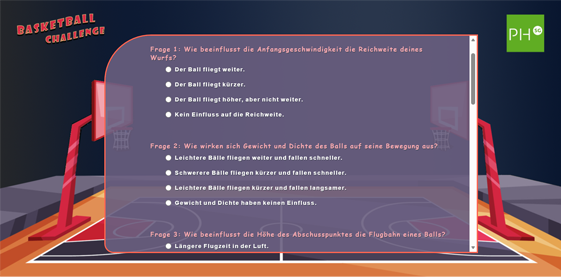
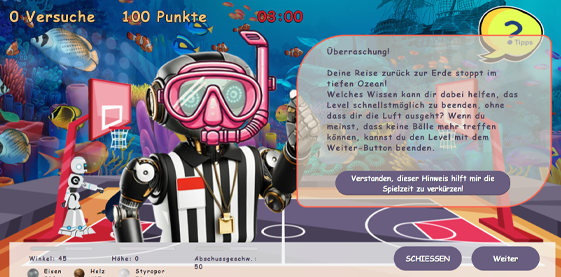
Throughout the game, a host character guides learners by providing instructions, hints, and feedback to support orientation and reflection during gameplay.

GRAVITAS
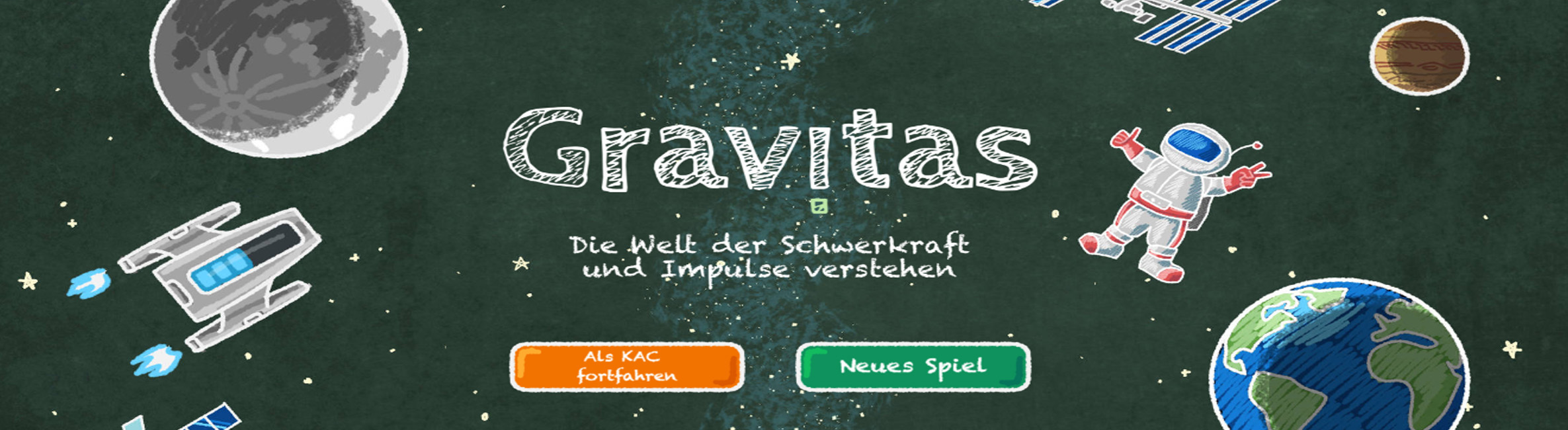
Gravitas is a simulation-based learning game designed to address persistent misconceptions in mechanics and gravitation. The game focuses on fundamental physics concepts such as gravitational force, free fall, orbital motion, weightlessness, and Newton’s third law. Its central goal is to help learners not only apply formulas, but fundamentally revise intuitive yet scientifically incorrect beliefs. Its central goal is to help learners understand and apply these principles within an interactive simulation environment.
Rather than presenting physics as a sequence of explanations, Gravitas confronts learners with their own preconceptions. Each level begins with a diagnostic question targeting a common misconception. Depending on the response, learners encounter visual conflict triggers and interactive simulations that challenge their initial assumptions. By actively manipulating parameters such as mass, gravity, orbital velocity, or thrust direction, they explore how physical laws determine motion. The game follows a structured six-level progression. Early levels address foundational gravitational misconceptions—for example, the belief that heavier objects fall faster or that gravity is caused by atmospheric pressure. Later levels extend understanding toward orbital mechanics and propulsion in a vacuum. The progression is intentionally scaffolded: conceptual complexity increases gradually while maintaining a cognitively transparent two-dimensional simulation space. Gravitas avoids competitive pressure and evaluative grading. Instead, it provides immediate, concept-focused feedback and allows learners to repeat simulations as often as needed. Errors are framed as productive entry points for reflection. In advanced levels, reconstructed concepts are applied in dynamic microgame environments, transforming abstract understanding into real-time embodied interaction.
Teachers may use Gravitas for classroom diagnostics or research-based pre–post assessment. Conceptual understanding and motivational variables can be measured before and after gameplay. All interactions are logged event-wise, allowing detailed analysis of learning trajectories.
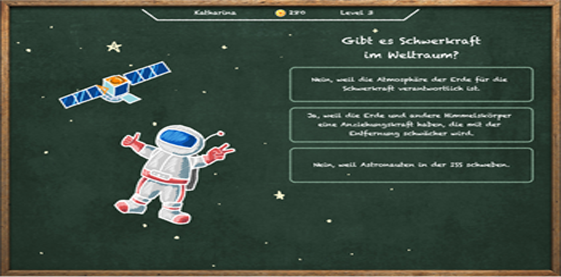
Each level begins with a multiple-choice question derived from well-documented misconceptions in mechanics. Incorrect answers trigger targeted cognitive conflict through short narrative anchors or visual demonstrations. Rather than correcting learners directly, the game creates a discrepancy between expectation and simulation outcome, prompting conceptual reflection.
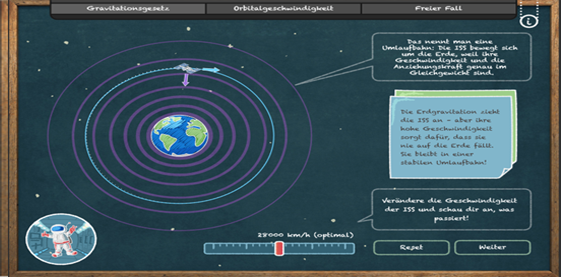
Learners manipulate physical parameters such as mass, gravity, orbital velocity, or thrust vectors. The simplified two-dimensional environment keeps cause-and-effect relationships transparent while allowing systematic experimentation. Simulations can be repeated freely, encouraging hypothesis testing and model refinement.
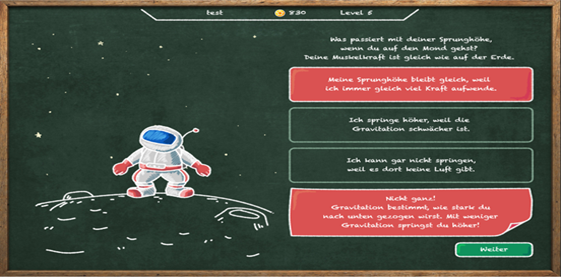
Feedback is immediate, neutral in tone, and explicitly tied to the underlying concept. It avoids evaluative language and instead highlights the scientific principle involved. This supports competence development without introducing performance pressure.
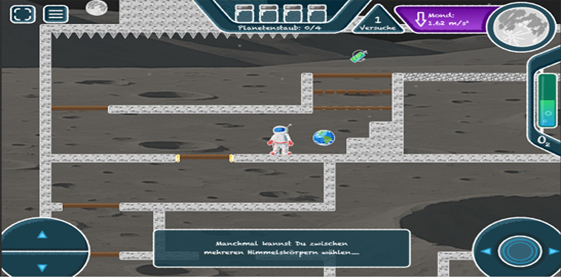
In later levels, conceptual understanding is enacted in dynamic environments. Learners experience gravitational differences across planetary bodies in a jump-based scenario and navigate a spacecraft using propulsion mechanics in a vacuum. Physical laws define the rules of interaction, translating abstract concepts into embodied gameplay.
PHYSIOS
Physios is a narrative, simulation-based physics learning game designed to address persistent misconceptions in mechanics through embodied interaction. The game integrates force, motion, friction, gravitation, impulse, and energy concepts within a cohesive adventure storyline.
The central narrative follows Pinky, who responds to a distress signal from Blinky after a rocket crash on a mysterious island. The rocket parts are scattered across multiple environments, each governed by different physical conditions. To recover them, learners must understand and strategically apply the physical laws that structure each world.
Rather than presenting physics as isolated formulas, Physios embeds physical principles directly into gameplay mechanics. Movement, resistance, acceleration, drift, buoyancy, recoil, and gravity are not explained abstractly but experienced through interaction.
Learning Through Experience
In Physios, physical principles are not explained — they are felt.
• In free fall, air resistance slows you down.
• On ice, Pinky keeps sliding even after you stop pressing a key.
• Underwater, buoyancy lifts you upward.
• In space, motion continues until another force changes it.
• On the Moon, Pinky jumps higher — but her mass stays the same.
Each game world introduces one dominant physical force and gradually combines it with others. Step by step, players develop a deeper understanding of motion, forces, and interactions.
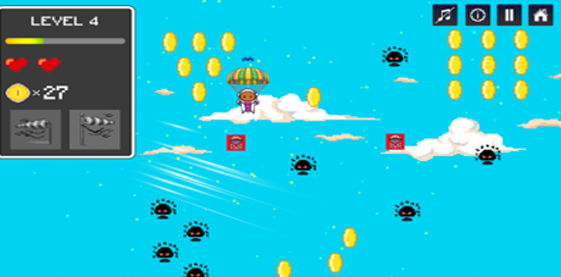
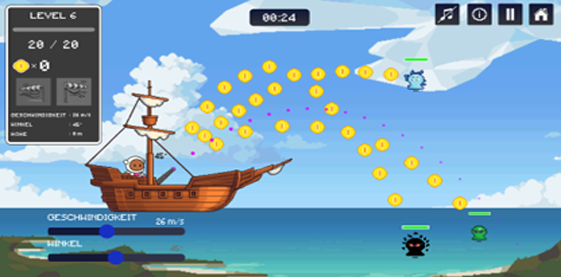
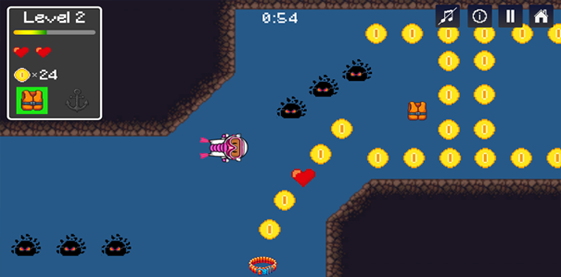
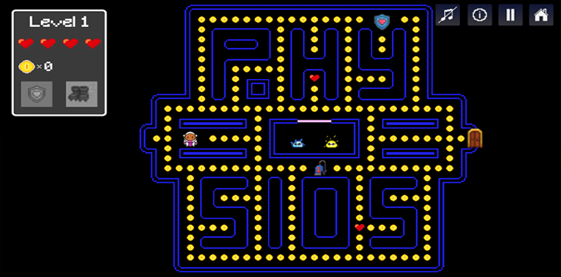
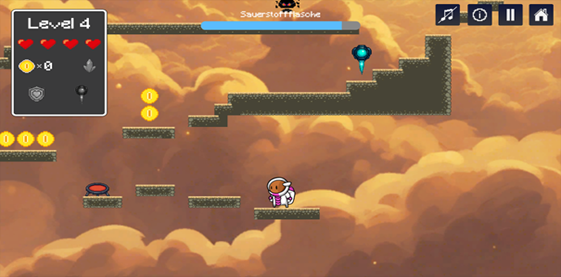
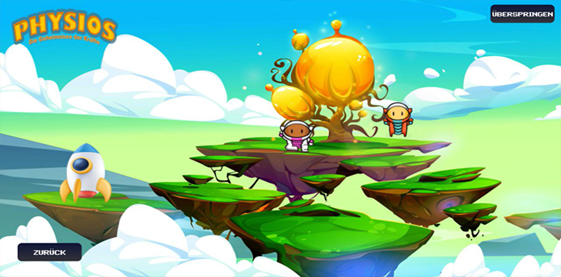
Physios makes physics tangible. Motion, resistance, acceleration, and gravity are not memorized — they are experienced.